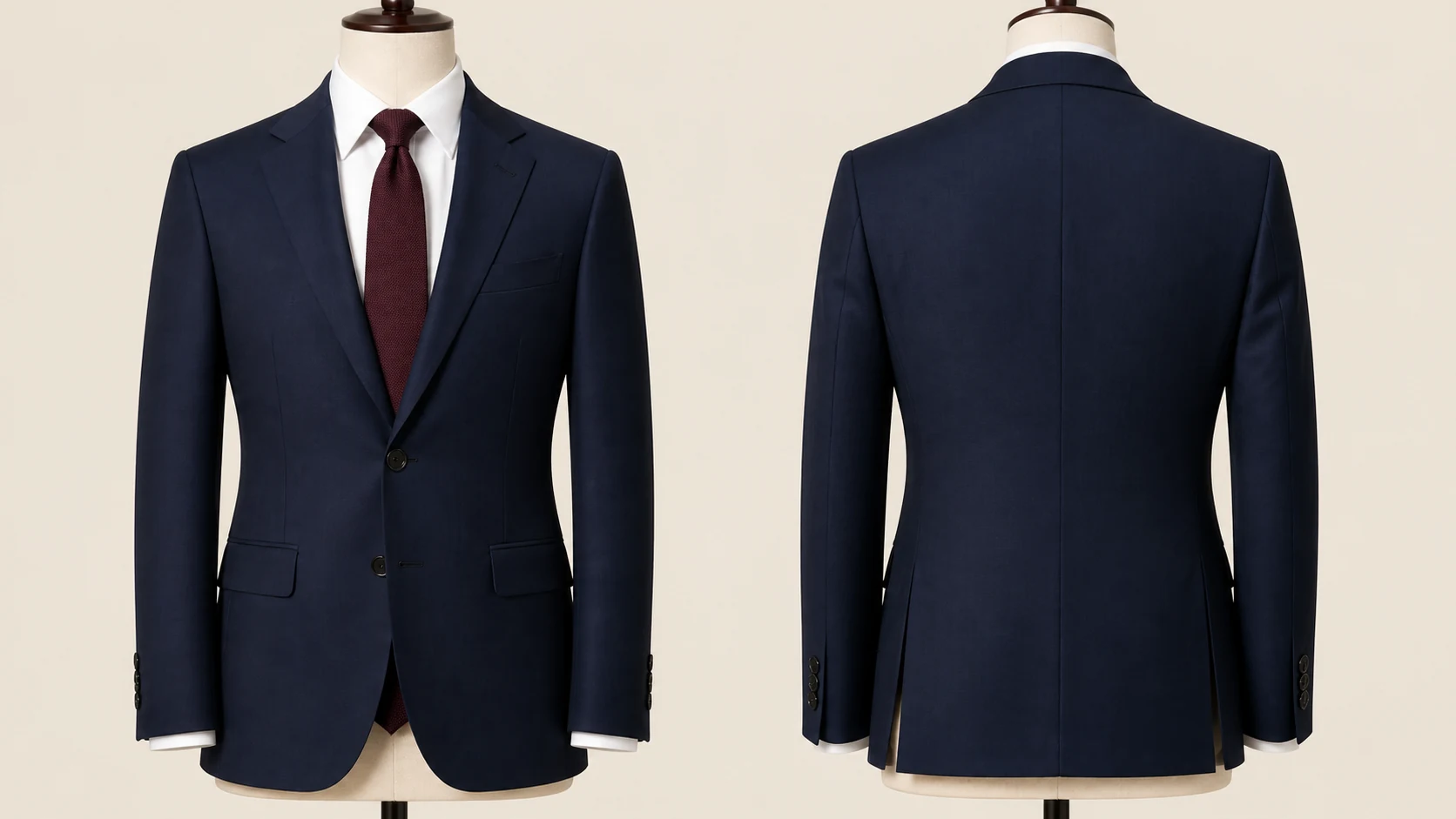
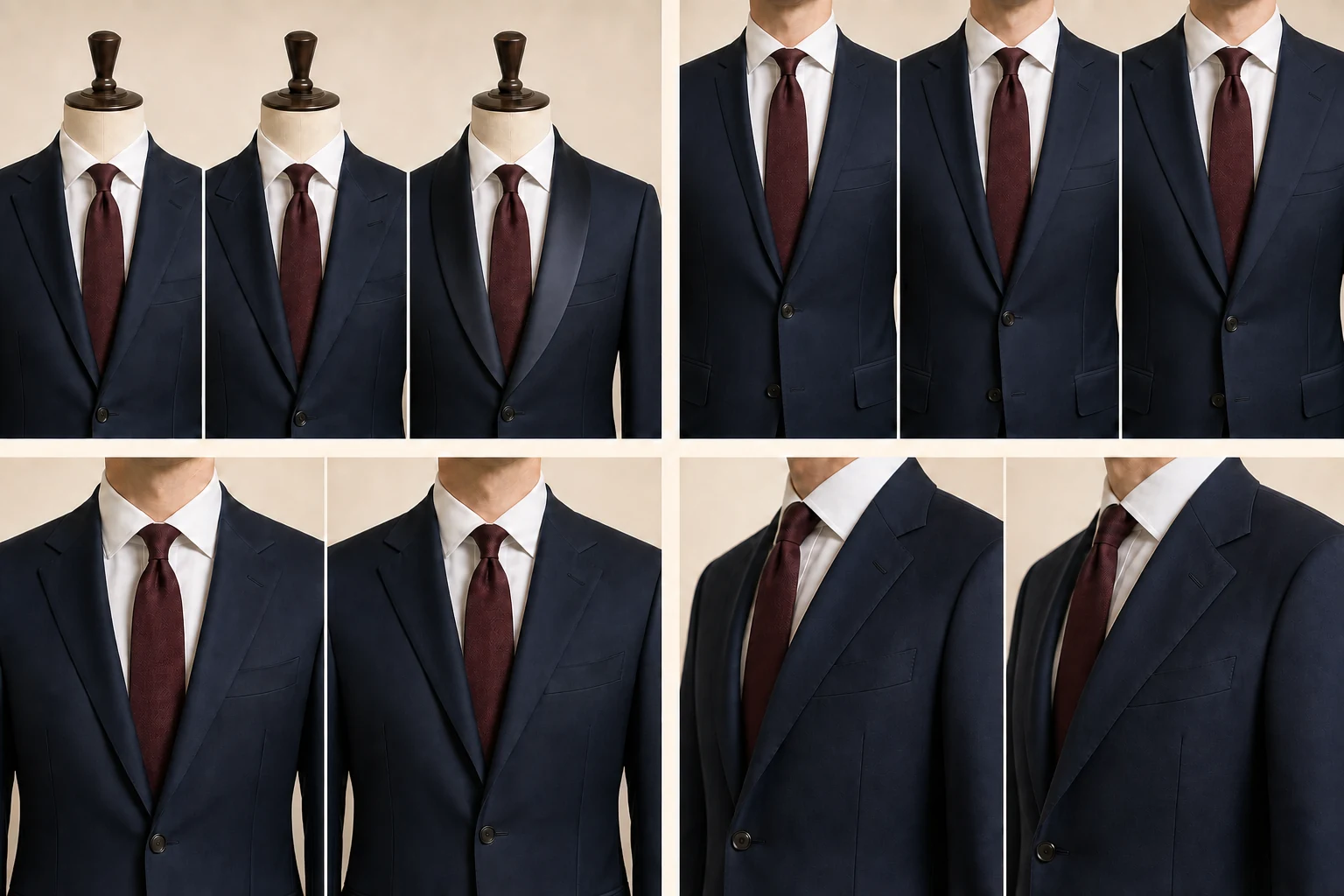
Coherent navy front-and-back suit overview; Eight accurate numbered callouts with endpoint dots; Eight large component close-ups; Alternate angles and correct-versus-incorrect comparisons
Key takeaways
Collar, lapel, shoulder, chest, waist, quarters, pockets, sleeves and vents form one connected silhouette.
Notch lapels are versatile, peak lapels project authority, and shawl collars make a continuous formal curve.
Natural, soft, roped and extended shoulders differ in padding, sleeve-head expression and apparent breadth.
Flap, jetted, patch and ticket pockets move from formal restraint to relaxed utility.
The jacket collar sits behind the shirt collar. The lapel turns back from the front edge and meets the collar at the gorge.
01What to noticeThe collar stays close to the neck, and the lapels lie cleanly without lifting, buckling or bowing.
02Why it mattersCollar contact reflects upper-back balance, while lapel shape and width establish much of the jacket’s character.
03What to sayKeep the collar close to my neck. I’d like a notch or peak lapel at this width, with a clean roll.
02
Shoulder
The shoulder line runs from the collar to the sleevehead. Its padding and construction may appear soft, natural or structured.
01What to noticeA clean, continuous line with no unintended dents, ridges, collapse or sleevehead divots.
02Why it mattersThe shoulder frames the silhouette and is one of the most difficult areas to alter after cutting.
03What to sayI prefer a soft, natural or structured shoulder. Please keep the sleevehead clean for my posture.
03
Chest & Shape
Cut, canvas and chest allowance determine how the jacket drapes before it narrows through the waist.
01What to noticeThe lapels stay against the chest and the fronts hang without collapse, bowing or diagonal strain.
02Why it mattersChest balance controls comfort and drape; waist shape should refine the silhouette without pulling it tight.
03What to sayGive me enough room through the chest to move, then shape the waist without pulling the fronts.
04
Buttons & Waist
The main fastening button creates the visual centre of the jacket. Its height—called the button stance—works with the waist suppression.
01What to noticeThe button closes without strain, the quarters fall evenly, and no X-shaped creases radiate from the fastening point.
02Why it mattersButton stance changes apparent torso length; excessive suppression distorts the fronts, lapels and pockets.
03What to sayPlace the main fastening button around my natural waist and use moderate suppression without tension.
05
Pockets
A jacket may combine a breast welt with jetted, flapped or patch hip pockets. Each choice changes its formality.
01What to noticeOpenings sit cleanly, flaps align, and the surrounding cloth remains free of puckering.
02Why it mattersPocket shape and placement affect both formality and the jacket’s horizontal balance.
03What to sayI’d like a welt breast pocket with jetted, flap or patch hip pockets, positioned to suit the jacket’s proportions.
06
Sleeve & Cuff
The sleeve is set at an angle—its sleeve pitch—to match the wearer’s natural resting arm position.
01What to noticeThe sleeve hangs without corkscrew wrinkles, and its hem reveals a narrow, even band of shirt cuff.
02Why it mattersCorrect pitch prevents twisting; correct length creates an intentional relationship between jacket and shirt.
03What to saySet the sleeve pitch to my natural arm position and finish the sleeve to show roughly one centimetre of shirt cuff.
07
Jacket Length
Back length is measured from the base of the collar to the hem. Front-to-back balance determines how the jacket hangs around the body.
01What to noticeFor a classic business proportion, the rear hem covers the seat and appears balanced when viewed from the side.
02Why it mattersLength changes the apparent relationship between torso and legs and determines appropriate seat coverage.
03What to sayI want a classic length that covers my seat; please check the front-to-back balance from the side.
08
Vents
Vents are openings at the rear hem. A jacket may have no vent, one centre vent or two side vents.
01What to noticeThe vents remain closed and vertical at rest, without crossing, splaying or exposing the seat.
02Why it mattersVents let the jacket move over the hips, ease sitting and improve trouser-pocket access; gaping may reveal tightness or a balance problem.
03What to sayI prefer double vents for movement and pocket access. Please make sure they hang closed when I stand naturally.